Wednesday, February 23, 2022
Lupine Publishers: Lupine Publishers | A Critical Review on Artavavah...
Lupine Publishers: Lupine Publishers | A Critical Review on Artavavah...: Lupine Publishers | Journal of Gynaecology and Women's Healthcare Abstract According to Ayurveda, health of a female starts i...

Tuesday, February 15, 2022
Lupine Publishers: Lupine Publishers | Sicilian Lemon and Honey Light...
Lupine Publishers: Lupine Publishers | Sicilian Lemon and Honey Light...: Lupine Publishers | Journal of Dairy & Veterinary Sciences Abstract The development of products enriched with physiological c...
Friday, February 11, 2022
Lupine Publishers|Formation of the International Fossil Fuel Agency (IFFA) as A Logical Proposal for Exiting from the Environmental Crisis of the Century
Lupine Publishers | Journal of Health Research and Reviews

Mini Review of Recent Studies
Increasing industrialization speed particularly among developing countries has been led to the influx of governments into available natural resources and consequently our planet has been facing with more environment destruction during recent years. From other side, the unfair competition for higher economic productivity between industrialized countries has created endless demand for generation of energy from traditional fossil fuels. The mankind manipulation in the environment under the pretext of industrialization caused to unwanted phenomena such as emissions of more greenhouse gases to the environment, air pollution, global warming, climate changes, water pollutions and etc. Among fossil fuels, coal is still as cheapest source of energy due to its abundance in many countries. According to the published outlook in 2017 by energy information administration (EIA), until 2040 the rate of coal consumption worldwide will rapidly enhance, and this means production of more greenhouse gases, air pollution and coal fly ash (CFA). The number of coal-fired power plants in the EU and US are more than 300 and nearly 175, respectively [1]. The most important consumers of coal in the world are including China, India, Canada, the former Soviet republics, some of East Asia, South Africa and South America countries. In order to overcome this critical situation, the amount of coal consumption in all around the world should be reduced to allow our planet to breathe again (Figure 1).
Figure 1: The Emission of Greenhouse Gasses by Coal-Fired Power Plants.

Generally, there are three points of views regarding this issue. Unlike the environmental activists and people those whom are deeply concern from this conditions and believe that all the coalfired power plants must be shut down, the politicians are strictly disagree with this comment because it can lead to some negative results like reduction of national production, fiscal crises and growth of unemployment. On the other hand, the scientific researchers have been working on this problem several years (Figure 2a). They are trying to find an appropriate answer to the presented question which is recognized as the biggest challenge of our century. The question is: “Is there any logical solution to produce clean energy from fossil fuels specifically from coal? Although, many researches have conducted on the capture and storage technologies (CST) as one of the most efficient methods to prevent the gaseous and dust pollutions, but this proposed technology is still expensive to be use in all coal-fired power plants. Achieving clean energy from coal will be possible if affordable technologies become widespread throughout the world (Figure 2b). In recent years, the researchers are focused on obviating this drawback of CST (Capture and Storage Technologies) through conversion of waste materials to the valueadded products for both industrial and environmental purposes.
Figure 2: a) Production of coal ash in a coal mine site (The mountain contains coal ash more than two million tons). b) The negative effects of CFA accumulation on the environment (destruction of natural eco-system), Savadkouh, Mazandaran, Iran. c) CFA emission into the air and environment by coal-fired power plant in Georgia. D) Accumulation of coal fly ash in the landfills around Georgia coal-fired power plant.

CFA is a byproduct of coal combustion process particularly in coal-fired power plants which is considered as one of the important hazards for both eco-system and living organisms. This waste solid material contains valuable aluminosilicate sources with honeycomb structure, high porosity and large surface area [2]. These unique properties have attracted the researcher’s attentions to manufacture of efficient, economical and eco-friendly adsorbents from CFA. Some of outstanding research works in the field of CFA are production of zeolitic/catalytic/geo-polymeric adsorbents for medical, environmental and industrial consumptions, thermal isolator, glass ceramics, chemical fertilizers and etc. One of the most interesting areas of CFA applications is in climate engineering program through pore condensation and freezing (PCF) mechanism. The investigations show that CFA particles play a significant role in cloud formation as a chemical ice nucleation. Therefore, these carried out efforts by researchers clearly illustrates that they are in right direction to find the best answer for the mentioned question (Figure 2c). Since, the time for reaching to the solution is not clear, we need to prevent from dangerous events derived from fossil fuels. The formation of an international organization to monitor and control of the air pollution caused by fossil fuels is necessary. The linkage of people, researchers and the decision makers from all around the world in the form of an international organization (IFFA) can help to more coordination and cooperation among them to have healthy ecosystems for our planet (Figure 2d). The IFFA can act through approval of incentive and punitive laws applicable for all countries that use from fossil fuels. All the countries should attend to IFFA and be under its supervision till they can use from its financial and scientific services. In addition, the IFFA should convince the governments to more supports of research works in the area of production of clean energy from fossil fuels. Ultimately, the promotion new technologies usable in new generation of coalfired power plants by IFFA will effectively decrease the pollution of fossil fuels.
For more Lupine Publishers Research and Reviews on Healthcare Open Access Journal Articles:
https://lupine-publishers-research.blogspot.com/
Wednesday, February 2, 2022
Lupine Publishers: Lupine Publishers| The Future of Biodegradable Pla...
Lupine Publishers: Lupine Publishers| The Future of Biodegradable Pla...: Lupine Publishers| Journal of Material Science Abstract Synthetic plastic waste is a major environmental issue around the worl...
Friday, December 10, 2021
Lupine Publishers| Right Versus Left-Sided Colon Cancer: Analysis of Epidemiology in Lebanese Patients
Lupine Publishers | Journal of Health Research and Reviews

Abstract
Objective: Recent studies have showed that right-sided colon cancer was more aggressive than left-sided and was more common in female and older patients. We examined the incidence of colon cancer by location (right versus left sided) in one university medical center, located in Beirut, Lebanon.
Methods: We collected the data of patients with colon cancer diagnosed between the years of 2011 and 2016 in Geitawi University Hospital, comparing the epidemiology of cases with right versus left sided colon cancer; concerning the following variables: age, sex, RAS status and the stage according to the American Joint Commission of Cancer AJCC.
Results: 96 patients were included, 61% had left-sided, 36% had right-sided, 1.5% had cancer in the transverse colon and 1.5% had synchronous left and right sided colon cancer. Patients with transverse and both right and left sided colon cancer were excluded from the study. We examined the incidence in patients under the age of 50; in whom screening is not recommended, versus patients over the age of 50; in whom screening is recommended. Patients with left-sided colon cancer were more common, more likely to be younger, to be males and to be diagnosed with a more advanced stage. In patients under the age of 50, 20% had cancer in the right and 80% had left-sided colon cancer.
Conclusion: Patients with right-sided were less common, predominantly males, older and with less aggressive stage than patients with left-sided colon cancer in a sub-group of Lebanese population.
Keywords: Colon Cancer; Right Sided; Left Sided; Epidemiology
Introduction
Colorectal cancer is one of the most commonly diagnosed cancers worldwide with over 1.2 million new cases and 608,700 deaths estimated to occur annually [1]. Colorectal cancer (CRC) is the second leading cause ofcancer-related deaths for both men and women in the United States, with 147,000 new occurrences and 50,000 deaths in 2009 [2]. Over the past years, the distinction between right-sided and left-sided colon cancer has been brought into consideration, regarding epidemiology, clinical presentation, pathology, and genetic mutations [3] Bufill in 1990 was the first to propose this, knowing that there are a number of differences between the sides of the bowel, for example the embryological beginnings; with the right bowel arising from the midgut and the left side from the hindgut, in addition to the difference in the vascular supply of each side [4].Epidemiological studies have demonstrated a gender and age relationship with a higher incidence of right colon cancer (RCC) in women and elderly people. Therefore, it has been suggested to consider colo-rectal cancer as three distinct tumor entities: right colon cancer (RCC), left colon cancer (LCC) and rectal cancer [5]. Right-sided colon cancers tend to be bulky, exophytic, polypoid lesions growing into the colon lumen and causing anemia. However, left-sided colon cancers tend to be infiltrating, constricting lesions en-circling the colorectal lumen and causing obstruction [6]. The idea of personalized medicine was introduced to the treatment of metastatic colorectal cancer (mCRC) when KRAS codon 12/13 mutations were identified as negative predictors of anti-EGFR-antibody (EGFR-mAB) treatment [7]. While there are many publications worldwide regarding this difference, it’s the first time in Lebanon we approach this issue. We studied patients with colon cancer admitted to Geitawi University Medical Center in an interval of 6 years (Figure 1).
Figure 1: The different entity of colon cancer Right Colon (ascending colon + hepatic flexure) Transverse Colon Left Colon (splenic flexure + descending colon + sigmoid).

Methods
Data selection
The data was detected from the archive of data base in Geitawi University Medical Center in Beirut. Patients selected were those diagnosed with colon cancer between the year of 2011 and 2016. The data selected included: patients age, tumor location, tumor stage and RAS status in stage 4 colon cancer.
Patient selection
All patients who were diagnosed with primary adenocarcinoma of the colon in Geitawi hospital from 2011 to 2016 were included in the study,96 patients were identified, 22 patients were excluded either because the location of the cancer was not exactly identified or because the workup and management was continued outside the hospital, also 2 patients were excluded because the Cancer was located in the transverse or synchronous side right and left colon. Inclusion criteria were as follows:
a) All patients diagnosed with colon cancer between 2011 and 2016
Exclusion criteria were as follows:
b) Transverse colon cancer
c) Synchronous left and right sided colon cancer
d) Patients continued the care out of the hospital
e) Patient without exactly primary location of colon cancer
Figure 2: Data collection and sidedness of colon cancer
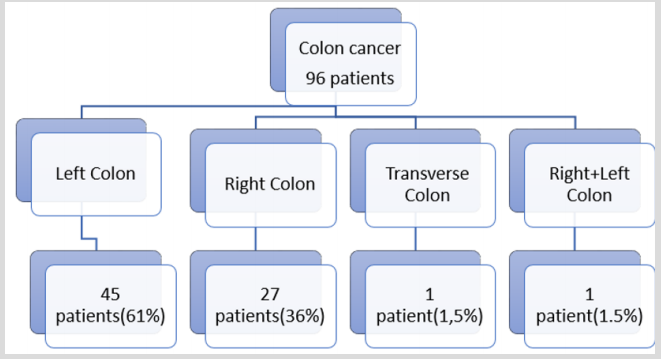
After considering the above criteria, the patient pool consisted of 72 patients. They were distributed into two groups according to the colonic tumor site: 45 cases were found to be LCC and 27 were RCC. We collected the information considering the age, sex, stage according to AJCC American Joint Committee on Cancer and RAS status because Ras mutation was identified as a negative predictor of anti-EGFR-antibody (EGFR-mAB) treatment in each group. Then we divided the patients according to the age into two groups, one included patients < 50 years of age and the other included patients≥ 50 years (Figure 2).
Result
Out of the 72 patients, two thirds 62.5% had LCC, 37.7% were right-sided, 57% were males, 43.5% were females, and the mean age of the patients upon diagnoses was 65 years (Table1). In the Left-sided subgroup, the mean age was 62.5 years, 53% were males, 47% were females, and according to the AJCC staging system; 49% had tumor with stage 4 upon presentation and 51% had tumor with stage less than 4.The RAS status was found to be wild in 30% and mutated in 61% of cases, knowing that the mutation was not done in 9% of patients.In the right-sided subgroup, the mean age was 68 years, 63% were males and 37% were females. Moreover, according to the AJCC staging system, 37% had stage 4 tumor upon presentation and 63% had tumor with stage less than 4. The RAS was wild in 20% and mutated in 30% of patients. The mutation was not tested in 50% of patients, of whom 75% did not test because they decided to receive palliative treatment only. With respect to the two groups divided according to age <50 and ≥50 years (Table 2), 13.9% of the total number of patients were under the age of 50. In the latter subgroup, 80% had LCC, 40% were males, 60% were females, and the mean age was 41 years. Moreover 40% were with stage 4 tumor and 60% had tumor with stage < 4 upon diagnosis. Regarding the subgroup including patients ≥ 50 years, 59.7% LCC, 59.7% were males and 40.3% were females. The mean age was 69 years, 46.8% were with stage 4 tumor and 53.2% had tumor in stage < 4 upon diagnosis (Figure 3) (Tables 1-2).
Figure 3: Epidemiologic differences between the 2-age group.

Table 1: Epidemiologic differences between right-sided and left-sided colon cancer.

Table 2: Epidemiologic differences between the 2-age group.

With respect to patients with right-sided colon cancer, 2 patients had stage 4 tumor with wild type RAS, both treated with EGFR targeted therapy. One patient passed away after progression in his disease status and the other one didn’t respond to first line treatment.
Discussion
Patients with RCC were, overall, older, more often of female gender, and had more advanced AJCC stages than patients with LCC [1]. Differences in clinical presentation, epidemiology, and tumor biology between right and left-sided colon cancer have long been reported in the literature [2-6]. This study retrospectively collected the data from the archive of Geitawi University Medical Center and showed that patients with LCC were more often of female gender and had more advanced AJCC stages than patients with RCC. There were more patients <50 years with LCC than with RCC, and the progression of the tumor was less aggressive compared to patients≥ 50 years. Our study showed that RCC is less aggressive than LCC and this result, despite the small number of patients included in our study, is in contradiction with the results published in the studies mentioned above, which may let us question the role of ethnicity and geographic factors in this issue. Thus, additional studies should be done to confirm this hypothesis. The retrospective analysis of RAS mutation status in patients with colon cancer of stage 4 showed that RAS was mutated in patients with LCC more than those with RCC. The last study of CALGB/SWOG 80405 (Alliance) showed that patients who received cetuximab and had left-sided tumor had a median overall survival (OS) of 36 months versus 16.7 months for patients with right-sided tumor. While patients who received bevacizumab had an overall survival of 31.4 months for those with left-sided tumor versus 24.2 months for those with right-sided tumor [8,9]. These findings played a role in changing the guidelines by limiting the use of cetuximab to patients with LCC only. Also, in our study 2 patients with RCC RAS wild type were treated with EGFR targeted therapy and both demonstrated progressive disease. These data concur with the above study and may lead us to restrict ordering RAS mutation studies to patients with RCC only, perhaps reducing the financial burden. Our study’s limitations were the small number of patients included with data collected from only one center, and it didn’t report overall survival or progression free survival.
Conclusion
The patients with right-sided colon cancer were more commonly males, older and had less aggressive tumor than patients with left-sided colon cancer, contrasting with the studies published internationally. Moreover, patients under the age of 50 were more often females, had LCC more than RCC, and the progression of the tumor was less aggressive than in patients above the age of 50 years.
For more Lupine Publishers Research and Reviews on Healthcare Open Access Journal Articles:
https://lupine-publishers-research.blogspot.com/
Monday, December 6, 2021
Lupine Publishers: Lupine Publishers | Nursing, Work and Mental Illness
Lupine Publishers: Lupine Publishers | Nursing, Work and Mental Illness: Lupine Publishers | Journal of Research and Reviews Introduction The worker's health is a public health whose object of stu...
Thursday, December 2, 2021
Lupine Publishers: Lupine Publishers| Modeling the Temperature of the...
Lupine Publishers: Lupine Publishers| Modeling the Temperature of the...: Lupine Publishers| Journal of Robotics & Mechanical Engineering Abstract This investigation approaches the artificial neural ...
Subscribe to:
Posts (Atom)
-
Lupine Publishers: Lupine Publishers| A Standard Pediatric Dental Clinic : Lupine Publishers| Journal of Dentistry and Oral Health Care Aft...
-
 Lupine Publishers | Journal of Health Research and Reviews Abstract Metabolism is the process your body uses to make energy f...
-
Lupine Publishers: Lupine Publishers | Characterization of Olive Oils... : Lupine Publishers | Journal of Food & Nutrition Abstract ...