Wednesday, July 31, 2019
Lupine Publishers: Lupine Publishers | Nanotechnology in Concrete: Sm...
Lupine Publishers: Lupine Publishers | Nanotechnology in Concrete: Sm...: Lupine Publishers | Journal of Civil Engineering Research Abstract Concrete changes the world. Nanotechnology changes...

Tuesday, July 30, 2019
Lupine Publishers: Lupine Publishers: The Biodiversity of Aquatic Gas...
Lupine Publishers: Lupine Publishers: The Biodiversity of Aquatic Gas...: Lupine Publishers: The Biodiversity of Aquatic Gastropods in the Step... : Earth and Environment journals | Lupine Publishers Abstract...
Lupine Publishers: Interior Environmental Design, Heal? | Lupine Publ...
Lupine Publishers: Interior Environmental Design, Heal? | Lupine Publ...: Open Access Journal of Complementary & Alternative Medicine | lupine Publishers Abstract Osteoporosis is a largely p...
Monday, July 22, 2019
Lupine Publishers: Lupine Publishers | Advances in Robotics & Mechani...
Lupine Publishers: Lupine Publishers | Advances in Robotics & Mechani...: Journal of Robotics & Mechanical Engineering | Lupine Publishers Smart Robotics for Smart Healthcare Abstract The...
Lupine Publishers| Neurosarcoidosis: A Review of the State of Art
Lupine Publishers| Medical Care Research and Review

Abstract
Keywords: Sarcoidosis; Neurosarcoidosis; Central Nervous System Diseases; Peripheral Nervous System Diseases
Introduction
Neurosarcoidosis
The involvement of the central and peripheral nervous system (neurosarcoidosis) is rare, clinically happening in about 5-10% of patients with sarcoidosis, with an average age of onset around 33-41 years [1]. Because of the rarity of this entity and the nonspecificity of its clinical and radiological findings, there is surely a high percentage of poorly diagnosed cases, mainly in an initial approach, as the neurological involvement can be found in up to 25% of autopsies from patients with sarcoidosis [1,2]. Non-specific symptoms such as fatigue, headache, cognitive dysfunction and mood disorders are frequent in cerebral neurosarcoidosis, but the clinical picture is usually dominated by cranial neuropathy or aseptic basilar meningitis. The damage of the optic nerve, the most frequently affected followed by the facial nerve, is associated with a poor prognosis in terms of visual recovery [3]. Spinal neurosarcoidosis can be divided into intramedullary and extramedullary involvement (leptomeningeal, extradural, vertebral and disc involvement); paresthesia and weakness of the lower extremities are the main symptoms, although it often presents as symmetric sensory motor polyneuropathy. Rarely, cases of sudden paraplegia can occur, along with bowel and bladder dysfunction [3].Diagnosis
The Zajicek criteria are the mostly adopted classification system for neurosarcoidosis established in 1999 and later revised. The other set of criteria belong to WASOG (World Association of Sarcoidosis and Other Granulomatous Disorders), updated in 2014. The specificity and sensitivity of these two options are unknown [4]. A definite diagnosis of neurosarcoidosis can only be established with a positive biopsy of the affected nervous system, frequently considered impossible or too invasive; for this reason, the biopsy is usually performed outside the central nervous system, in a peripheral nerve or another affected and more accessible organ (as neurosarcoidosis frequently coexists with other organ involvement). None of the serum biomarkers used nowadays have been accepted as the one that stablishes the diagnosis, including the angiotensin converting enzyme (ACE) or the serum soluble activity of the interleukin-2 receptor (sIL2 receptor) [1].Levels of ACE in cerebrospinal fluid (CSF) have a low sensitivity (between 24-55%), but may raise the suspicion of neurosarcoidosis due to its high specificity (around 94%). It seems that there is no correlation between serum and CSF levels of ACE and serum levels do not correlate with the degree of clinical activity [5]. Image findings should not be considered alone for the diagnosis of neurosarcoidosis, but always included in an appropriate diagnostic algorithm. Magnetic resonance imaging (MRI) is the preferred imaging technique because it provides the best definition for brain and spinal cord disease [3,4]. Meningeal involvement can appear as nodular or diffuse enhancement on contrast-enhanced T1- weighted images, mainly in the basilar meninges, as opposed to intraparenchymal lesions that manifest as multiple small, nonenhancing periventricular or subcortical white matter lesions, with high signal on T2-weighted images [3]. Fluorodeoxyglucose positron emission tomography (FDG-PET) can reveal areas of hypermetabolism that correspond to active lesions in asymptomatic sites, which can be used to identify suitable sites to do a biopsy, although there is a lack of evidence regarding the use of FDG-PET and its usefulness in neurosarcoidosis [4]. Histopathologically, neurosarcoidosis is characterized by the presence of noncaseating epithelioid granulomas, the same lesions as those found elsewhere in the body in systemic disease. These granulomas although not specific for sarcoidosis, are valuable diagnostic clues [1]. The differential diagnosis includes: tuberculosis, especially in endemic areas, other infections like histoplasmosis, aspergillosis and cryptococcosis, but also granulomatosis with polyangiitis [6].
Treatment
There are no international guidelines to treat neurosarcoidosis and randomized clinical trials are lacking to make treatment recommendations. Taking this into consideration, there is a general consensus that corticosteroids should be the first line of treatment, as the majority of patients improve with only glucocorticoids [1,3,7]. If the symptoms are severe, with involvement of the central nervous system, a short course of intravenous steroids is usually given, up to 1g of methylprednisolone a day for 3-5 days. Subsequently, or if the clinical symptoms are less severe, oral steroids can be administered (e.g. prednisone 40-80mg, around 1mg/kg/day), with gradually descending pattern until the lowest effective or maintenance dose (around 10mg/day). Relapse often occurs after the dose of glucocorticoids is tapered down; if the required maintenance dose is more than 10 mg a day, or if clinical response is insufficient, it is recommended to add a steroid-sparing immunomodulatory agent. The evidence is in favor of methotrexate (between 10-25mg once a week), but other immunosuppressant drugs can be considered, such as azathioprine (at 2mg/kg/day, maximum 200mg/day) [1,3,7]. In severe resistant or refractory cases, cyclophosphamide is classically used (500-1000mg iv every 2-4 weeks, or at a dose of 0.5g/m2 of body surface area every 4 weeks).Anti- TNF-alpha agents are becoming strongly recommended because of the increasing evidence of rapid reversal of clinical and radiologic features with these agents, especially infliximab (intravenously at a dose of 3-5mg/kg at weeks 0,2 and 6, with intervals of 4-6 weeks thereafter); some groups are already considering this treatment option before cyclophosphamide [3,7]. Patients treated with long-term infliximab could develop anti-infliximab antibodies that will lead to treatment failure. To avoid this, concomitant methotrexate is recommended, as an immunomodulatory agent. When to stop the treatment remains controversial [7]. Surgery is generally limited to the diagnostic biopsy rather than to the therapeutic use. Cranial mass lesions could benefit from radiation therapy, although this is not recommended as standard treatment [3].
Prognosis
There is no cure, but optimal immunosuppressive therapy can achieve clinical remission in approximately two thirds of cases, along with variable improvement in imaging findings. Despite the use of new therapies, close to one third of patients remain stable, deteriorate or die [3,8].Conclusion
For more Lupine Publishers Open
Access Journals Please visit our website:
https://lupinepublishersgroup.com/
https://lupinepublishersgroup.com/
To Know More About Open Access Publishers Please Click
on Lupine Publishers
Thursday, July 18, 2019
Lupine Publishers: Surfactant Mediated Biodegradation of Aromatic Hyd...
Lupine Publishers: Surfactant Mediated Biodegradation of Aromatic Hyd...: Journal of Oceanography | Lupine Publishers Abstract Aromatic hydrocarbons (toluene and xylene) are highly water soluble and their...
Increased A1c Testing among Members of A Large Coordinated Care Organization in Southern California- Lupine Publishers
Medical Care Research and Review- Lupine Publishers
Abstract
Keywords: A1C test; Diabetes; Prediabetes; Population health
Introduction
Blood glucose measurements are integral to the diagnosis of diabetes, its management and more recently identification of prediabetes. Prediabetes is a high risk state for developing diabetes, where blood glucose is elevated above normal levels but not yet high enough to be considered diabetes. In the case of the A1C test, categories include< 5.7% (normal), 5.7%-6.4% (prediabetes) and ≥ 6.5% (diabetes) [3]. The A1C test is used by diabetic patients and their physicians to monitor blood glucose. Regular measurement of A1C levels enables patients with diabetes and their physicians to know whether patients are reaching their A1C goals in order to minimize the adverse health outcomes associated with uncontrolled diabetes. The A1C test has the advantage of requiring no preparation and it is not sensitive to the time of day, unlike other blood glucose tests. Consequently, many providers are hopeful that the ease of the A1C test will decrease the number of undiagnosed diabetics as well as allow for identification of patients with prediabetes and therefore earlier intervention and prevention of diabetes [6].
Case Study Site, Study Goals and Results
Table 1: Average Number of A1c Tests per Member per Year:
2007-2016.
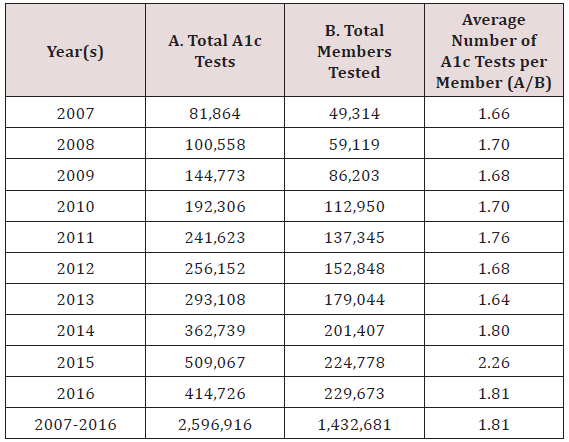
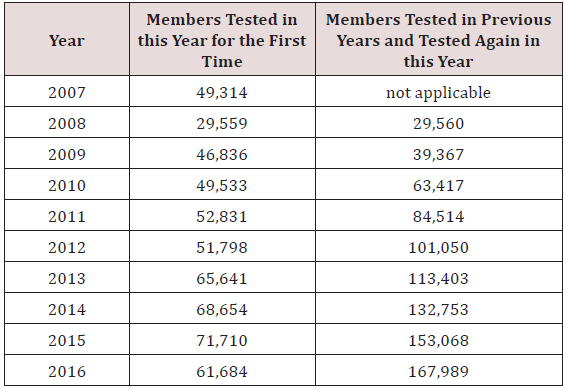
Table 2: Number of Newly Tested Members and Members with
Repeat A1c Testing: 2007-2016.
Discussion
To Read More Click on Below Link
https://lupinepublishers.com/research-and-reviews-journal/fulltext/increased-a1c-testing-among-members-of-a-large-coordinated-care-organization-in-southern-california.ID.000125.php
For more Lupine Publishers Open Access Publishers Please Visit our Website
https://lupinepublishersgroup.com/
For More Medical Care Research and Review Articles click on below link
https://lupinepublishers.com/research-and-reviews-journal/
To Know more about Open Access Publishers please click on Lupine Publishers
Subscribe to:
Posts (Atom)
-
Lupine Publishers: Lupine Publishers| A Standard Pediatric Dental Clinic : Lupine Publishers| Journal of Dentistry and Oral Health Care Aft...
-
 Lupine Publishers | Journal of Health Research and Reviews Abstract Metabolism is the process your body uses to make energy f...
 -
 Lupine Publishers | Journal of Health Research and Reviews bstract Purity of the person is guarantee of his health. Spiritual and...